Skip to content
Home
FREN
Follow Zwip

Around the clock darts rules

Hit the 1, then the 2, and so on up to the 20, then the bullseye. The perfect game for beginners, for warming up, and for measuring your accuracy.

Updated on 20 November 2026

In short
  • Everyone starts on 1 and must hit the numbers in order, up to 20.
  • After the 20, you hit the bullseye to win.
  • Single, double or triple: in the classic version, any hit on your target moves you to the next number.
  • No maths, no bust: perfect for beginners and kids.

How to play

Every player starts on 1. On their turn, they throw three darts and try to hit their number. As soon as they hit it, they move on to the next one: 2, then 3, and so on. After the 20, they have to hit the bullseye. The first to do it wins.

Léa is on 4. Her first dart hits the 4: she’s on 5. Her second hits the 5: she’s on 6. Her third misses.

Next turn, she starts again from 6.

You can move several numbers in one turn: three darts, three hits, three numbers. A dart off your target doesn’t count and doesn’t move you back.

Jumps

In the most popular variant, the ring counts:

Hit on your targetYou move
Single1 number
Double2 numbers
Triple3 numbers

Paul is on 7 and hits double 7: he moves to 9. Then triple 9: he moves to 12.

You never jump past the bullseye: a triple 19 takes you straight to the bullseye, no further.

Variants

  • 20 down to 1: go round the other way, counting down.
  • Doubles only: only the double of your target counts. Excellent practice for 501 finishes.
  • Triples only: the version for experienced players.
  • Board order: follow the numbers as they sit on the board (20, 1, 18, 4…) instead of counting up.
  • Double bullseye finish: only the 50 wins.

Practising with Around the clock

On your own, Around the clock is an accuracy test: count the darts you need to go round, and try to beat your record. Without the jumps you need at least 21, one per number: every extra dart is a miss. The game works every sector of the board, including the ones you rarely aim at, like 11 or 14.
The Zwip twist

In Zwip, Around the clock is called Orbit.

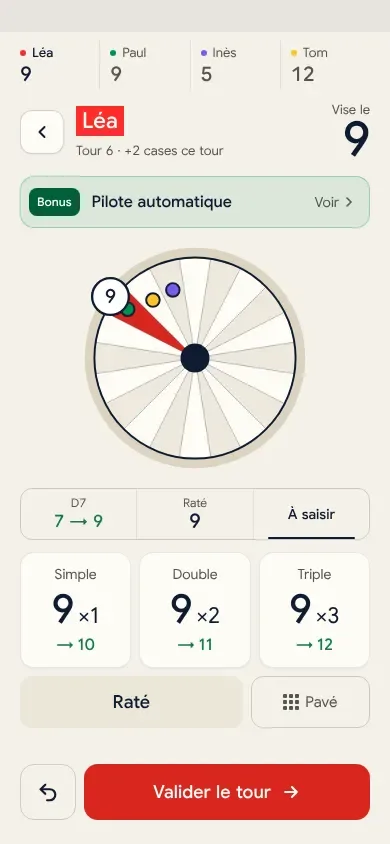
Everyone’s target lights up on a board drawn in the app, a double moves you 2 squares and a triple 3. And Orbit has its own cards: jumps, black holes, comets and collisions that change the race every turn.

  • Jumps on doubles and triples, 20 down to 1, double bullseye finish: your choice.
  • The Rocket: hit with your 2nd and 3rd darts and you throw one more.
  • On your own, against the clock, to beat your record.
A turn of Orbit in Zwip: the board, the target square and the other players
Illustration of the card Double TroubleBonus
Double Trouble
Every dart counts double
  • Every hit this turn moves you twice as many steps: a single 2, a triple 6.
  • Without jumps, every hit moves you 2 steps. You never jump past the bullseye.
Illustration of the card The Stand-InBonus
The Stand-In
Pick an opponent to throw for you
  • Pick an opponent: they throw your turn, at your target, and the steps are yours.
Bonus
Hyperspace
Hit a number further than your target: you jump to it. 3 steps max
  • This turn, a number up to 3 steps past your target makes you aim at that number: on 7, hitting 10 sends you to 10.
  • Doubles and triples don’t count for the jump; your target moves you forward as usual.
  • Not drawn when you’re aiming at 20 or the bullseye.
Malus
Black hole
Every dart that misses your target moves you back one step. 2 max
  • This turn. Never below 1.
  • A dart that falls out counts as missed.
  • Not drawn when you’re aiming at 1, or when you’re last in the standings.

Frequently asked questions

Do you have to hit the single, the double or the triple?

In the classic version, any of them: the whole number counts. The jumps variant moves you two numbers on a double and three on a triple; other variants only accept doubles, or only triples.

Do you have to finish on the bullseye?

Usually, yes: after the 20, you hit the bullseye, 25 or 50. Some versions stop at the 20; others require the 50, the heart of the bullseye.

How long does a game take?

About ten minutes with two or three players. On your own, as practice, time yourself and count your darts.

Is it a good game for kids?

Yes: no maths and no bust, just numbers to hit. For younger players, move one number at a time without the jumps, or aim at singles only.

Other games