How to play
Halve it is played over a fixed number of rounds, often nine. Each round has its target, the same for every player, set in advance. On their turn, each player throws three darts at the round’s target:
- every dart on the target adds its points to their score;
- if none of their three darts hits the target, their score is halved.
After the last round, the player with the most points wins.
Example rounds
There’s no official list: every club has its own. A classic one:
| Round | Target | What counts |
|---|---|---|
| 1 | 20 | Every dart in the 20 |
| 2 | 16 | Every dart in the 16 |
| 3 | A double | Any double |
| 4 | 17 | Every dart in the 17 |
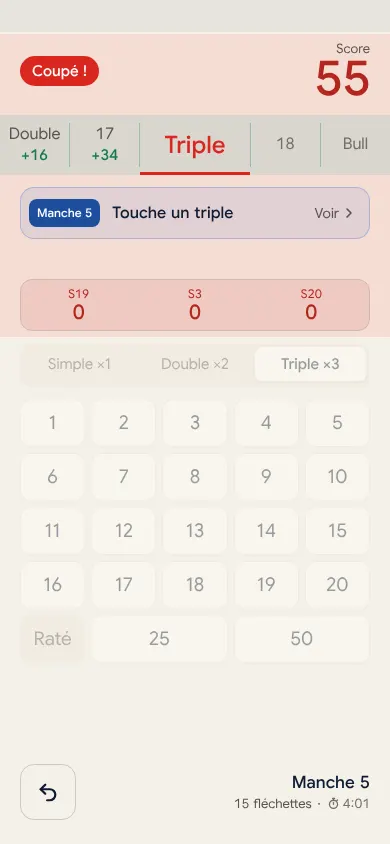
| 5 | A triple | Any triple |
| 6 | 18 | Every dart in the 18 |
| 7 | The bullseye | The 25 and the 50 |
| 8 | 19 | Every dart in the 19 |
| 9 | A total | The three darts must make a set total, for example 41 |
Léa has 110 points. Round 5, a triple: she throws 19, 3 and 20, no triple. Her score is halved: down to 55.
Round 6, the 18: she hits triple 18 and single 18. +72 points: back up to 127.
The starting score
Many players start from 0. But at 0, halving costs nothing: the first missed round is free. To make every round count, players often start from a small score, like 40 points.
Why it’s great practice
Halve it makes you aim at the whole board, not just the 20: numbers you never aim at, the doubles that finish a 501, the triples that make big scores, and the bullseye. Halving punishes missed rounds more than average ones: consistency matters more than flashes of brilliance.